Hello and welcome to the third installment of Strong Female Characters: May We Read Them. May We Write Them. May We Be Them. Today I will be discussing one of my favorite girls in all of literature—Lucy Pevensie.
I was quite young when I first read the Narnia series, and I fell in love with it instantly. There are so many deep and wonderful themes and moments throughout the books that make it one of my favorite series. As this post is about one specific character, rather than the books themselves, I will resist the urge to fill several pages singing its praises. Suffice it to say, if you haven’t read them, you should.
As with the previous two posts, I will go ahead and issue a spoiler warning for those who have not read the Chronicles of Narnia and want to. Even though the first book of the series was published in 1950, I suppose there is no expiration date on courtesy. And now, we begin…
The Pevensie children—Peter, Susan, Edmond, and Lucy—are introduced in the second book of the series, The Lion, the Witch, and the Wardrobe. As this post is about Lucy Pevensie, we will be skipping over The Magician’s Nephew, which is chronologically the first book in the series.
When our story opens, the Pevensie children are boarding a train to the country to escape the bombs being dropped on London during WWII. Lucy is only 8 years old as she enters the home of Professor Kirke (the same Digory Kirke from The Magician’s Nephew) with her siblings and her life is forever changed. This is a truly amazing fact when you consider all that she accomplishes and overcomes over the course of this book alone.
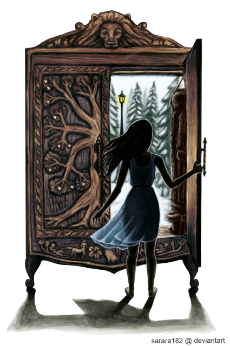
During an innocent game of hide & seek, Lucy stumbles into an old wardrobe (which, unbeknownst to her, was built from the wood of a tree grown from a Narnian apple brought back by Digory Kirke) and finds herself in the land of Narnia. Her age and naivete are clearly visible as she befriends a strange faun she meets in the woods, and accompanies him to his home for some afternoon tea. The faun, Tumnus, turns out to be in the pay of the notorious White Witch, and is on the brink of turning Lucy over to her; he had orders to capture any human child found in Narnia and take them to the witch to stop the fulfillment of an old prophecy which predicted her death. Despite her age and initial poor judgement, Lucy keeps her wits about her, and convinces Tumnus to let her go. She heads back through the wardrobe and finds herself, once more, in England at the home of Professor Kirke.
Lucy soon realizes that no earth time has passed in the hours she was away in Narnia. Her siblings think she is playing a game at first but, when Lucy refuses to admit this, they start to believe she is telling lies. Despite pressure from all her siblings, and merciless teasing from Edmond, Lucy stands firm in her belief in and insistence of the existence of Narnia. Even when Edmond himself finds his way into Narnia (meeting the White Witch and joining her side), and refuses to admit it to the others, Lucy will not budge. She is soon vindicated when all four of the Pevensie children find their way there when running from the housekeeper, Mrs. Macready. This is when the real adventures begin.
When they reach Narnia and discover that Tumnus has been taken captive by the witch for letting Lucy go free, Lucy convinces her siblings to stay in Narnia and try to rescue him. She displays a goodness and courage that outshines her siblings, all of whom are older than Lucy. Despite all that happens next—teaming up with Mr. and Mrs. Badger, Edmond running off to join the witch, being hunted by wolves, journeying to the Stone Table to see Aslan, Edmond’s rescue and return, the witch herself coming to speak with Aslan, and more—Lucy stands strong; an amazing feat for an 8-year-old girl.
Then comes one of the most heart-wrenching moments in the series—the death of Aslan at the hands of the White Witch. Lucy witnesses this with her sister, Susan, yet still hold onto hope. When Aslan comes back to life, Lucy and her sister ride with him to free the prisoners from the witch’s castle and into the battle against her armies. Aslan’s forces, led by Peter, are victorious, and the prophecy is fulfilled—ending the witch’s reign and her life, and seating the Pevensie children on the four thrones at Cair Paravel. Lucy reigns alongside her siblings as Queen Lucy the Valiant for years to come.
Eventually, the Pevensie siblings find themselves back in England, where they return to their former ages and life, for a while…
A few years later, they are summoned back to Narnia to help Prince Caspian reclaim the throne of Narnia from his uncle, the usurper Miraz. Still a young schoolgirl, Lucy once more rises to the occasion. At first, she is the only one who can see Aslan and attempts to convince the others to follow him. When they will not, she begrudgingly follows Peter in the wrong direction. Once again, Lucy demonstrates incredible faith; even when no one else believes her, she refuses to cave to the pressure and insists that she has seen Aslan. When she speaks to Aslan face to face, he utters one of my favorite lines in all of literature: “Courage, dear heart.” Lucy has it in spades.
Lucy’s courage and faith eventually lead the group to safety and to the army of Caspian. This allows them to join forces to defeat Miraz and put Caspian back on the throne. Once again, the Pevensies are taken from Narnia and, once again, they return—some of them anyway. Edmund and Lucy find their way back a little while later with their cousin, Eustace, and board the Dawn Treader with their old friend, Caspian.
Eustace is an awful and pitiful creature when the story starts, and Lucy is the one who shows the most kindness and compassion toward him in spite of this. She shows strength and fortitude as they are at sea, rationing their food and water. She holds her own on a ship of grown men, all of whom are trained sailors or warriors. She also shows bravery and ingenuity on their many trips ashore.
On one such excursion, she finds herself the only one who can save her crew from a tribe of Dufflepuds (invisible, one-footed humanoids) intent on using her to make them visible once more. In one of my absolute favorite scenes, Lucy swallows her fears and enters the house of the magician alone, climbing the steps to find his spellbook. With Aslan’s help, she resists the siren call of a spell to make her more beautiful, and fulfills her mission to help the Dufflepuds.
At the end of the story, Lucy sails to the end of the world with her brother and cousin, where they find a portal back to England. This is the last time Lucy is able to visit Narnia while she lives, yet she handles it with grace. After the adventures end, Lucy maintains her belief in Narnia and faith in Aslan, even when her sister tries to convince her and their brothers that it was all in their imagination. Lucy is true to the very end.
Throughout the series, Lucy exhibits a faith that has always inspired me. She stands strong in her beliefs, never wavering in the face of doubt or criticism from others. She steps out bravely into that faith, following Aslan wherever he leads. She fights in numerous battles and faces countless dangers. She even rules the land of Narnia for almost two decades of their time as one of history’s most beloved queens. Not a bad legacy for someone who is just 17 years old when the last book ends. Tragically, this book includes the death of Lucy, Peter, and Edmund in a train crash. But their faith allowed them to spend eternity in Aslan’s country with him. At the end of the day, that’s the best thing a brave girl of faith like Lucy Pevensie could ever have hoped for.