Hello and welcome to the fourth and final installment of Strong Female Characters: May We Read Them. May We Write Them. May We Be Them. Guess what—I saved the best for last.
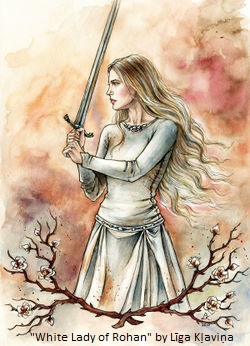
As I’ve mentioned before, my dad read the The Lord of the Rings books to me at an early age, and I was instantly hooked. There are several storylines and characters that I fell in love with, but none more so than Eowyn, Shieldmaiden of Rohan.
As with many characters brought to life on the silver screen, the movie portrayal does not do Eowyn justice. Disclaimer—Miranda Otto is a phenomenal actress and I think she was the perfect choice for this character. My issue lies, as it often does, with the way she was written in the script. Do I think these are some of the best movies and best adaptations of all time? Yes. Do I think they could have been better? Also yes.
The issue I have with her depiction, other than the fact that they left the end of her story out entirely, lies with the fact that they reduced her at points to a naive girl pining after a man who can never love her. Yes, they include some of her strength and heroism in the film, but her character was so much more than they allowed her to be. I will briefly touch on this in more detail as I go. All things considered, though, I still loved her in the movies.
Eowyn’s story begins in a place of darkness—her parents died when she was young, and she and her brother were left to the care of her uncle, King Theoden. At his heart, Theoden is a good and noble man, but his mind was corrupted by Grima Wormtongue at the bidding of Saruman. When we first meet the king in The Two Towers, his mind is not his own, and he is fading away, leaving the kingdom to the mercy of Saruman. Eowyn does her best to care for the king, but it’s a thankless job with little to show for it. Meanwhile, Wormtongue visibly lusts after her, hoping to take her for his own once the kingdom falls.
Eowyn is utterly alone—her uncle doesn’t recognize her, her brother has been exiled by Wormtongue, and she has no one but herself to count on. A lesser person would have caved under the weight of it, but not Eowyn. She grew cold and stern, but did not crumble.
When Gandalf and his companions arrive in Rohan, he is able to free Theoden from Saruman’s grasp and restore him to his right mind. This relieves Eowyn from her duty of care, but does not provide her the freedom she so desires—she is still a woman and, as such, is not able to ride to battle with her countrymen to defend the home and the people she loves. As the kingdom of Rohan takes shelter of Helm’s Deep, Eowyn is left in charge of the people as those she loves go to war without her. This takes its own kind of strength.
One of my absolute favorite exchanges in all of literature is featured in The Two Towers as Eowyn and Aragorn discuss this reality.
“A time may come soon,” said he, “when none will return. Then there will be need of valour without renown, for none shall remember the deeds that are done in the last defence of your homes. Yet the deeds will not be less valiant because they are unpraised.”
And she answered: “All your words are but to say: you are a woman, and your part is in the house. But when the men have died in battle and honour, you have leave to be burned in the house, for the men will need it no more. But I am of the House of Eorl and not a serving-woman. I can ride and wield blade, and I do not fear either pain or death.”
“What do you fear, lady?” he asked.
“A cage,” she said. “To stay behind bars, until use and old age accept them, and all chance of doing great deeds is gone beyond recall or desire.”
This conversation has stayed with me my entire life. I don’t possess the bravery or fighting skills of Eowyn, but this helped me reshape my thinking around fear and what it would look like to live life well. There are few things scarier than a cage—to live a life out of your control and never be able to do the things you truly want or chase the dreams that call to you. Not everyone in this world has a choice and it is the duty of those who do to speak for those who cannot speak for themselves. And for those of us who have a voice and walk in freedom—it is our duty not to waste either.
Alright, I’m back from that tangent. The first book sees Eowyn falling into what she believes at the time is love with Aragorn son of Arathorn. She discovers in hindsight (as so many of us have) that what she truly loved was the idea of him and what he represented. But in the books she never lost her head or her composure.
In The Return of the King, Eowyn is, once again, left behind as the men ride off to war, heading now to the fields of Pelennor at Minas Tirith in the kingdom of Gondor. This time, however, she refuses to allow it; she disguises herself as a man by the name of Dernhelm, joining the company and riding to Minas Tirith. What’s more, she takes Merry with her after the men tell him he must also remain behind. As I mentioned, it is the duty of those in power to help those without it, and Eowyn uses her resources to help Merry. And it’s a good thing, too—these two are responsible for killing the Witch King of Angmar when no one else can.
That’s something else I love about these books and this character. There was a prophecy saying that no man could kill the Witch King. As with tyrants and their cronies throughout time, he failed to see the value and the danger in those he perceived as “less than” or “unimportant.” His inability to realize that a woman (with the help of a hobbit) might pose a threat to him cost him his life and helped turn the tide of battle in favor of those who fought against the forces of darkness.
There’s another part of Eowyn’s story that has always meant so much to me. That is why I had such a hard with with it being left out of the movies. She is gravely injured by the Witch King and almost loses her life. She is placed in the houses of healing in the city of Minas Tirith, where she is ultimately healed by Aragorn (in a beautiful confirmation of him as the rightful King of Gondor which was also tragically cut from the film). While she is there, she gets to know Faramir, brother of Boromir, who does what Aragorn cannot—he heals her heart. It is a slow unraveling of the walls she has built up over so many years and a gradual growth of friendship and love between two people who could not possibly be better suited for each other.
Now don’t get me wrong—I am not saying that a woman needs a man to fix her or make her complete, and I do not believe that in any way. Eowyn, especially, had a strength all her own and I believe that she would have found that healing and wholeness without any assistance. In many ways she did. But the fact that she allowed herself to trust, to be vulnerable, and to open her heart to love, is its own kind of strength—one that many people do not possess. And the kindness and tenderness of Faramir shows a similar strength that many people could learn from. I love this storyline, not because they needed each other, but because they chose each other, and opened themselves up to something bigger than both of them and found love and healing there. I could honestly do an entire separate post on this, and perhaps someday I will. It might be interesting to explore some of my favorite relationships throughout literature at some point. But for now, let’s round this out by talking a bit more about Eowyn.
I love how Eowyn is able to stand strong in the midst of circumstances that would have completely shattered most people. It’s also powerful to see her exhibiting several different kinds of strength. If a person has courage without compassion, are they truly strong? After all, isn’t cruelty one of the surest signs of weakness? Eowyn sees through Wormtongue when no one else does. She holds fast to her belief that her uncle and her kingdom can be restored to their former glory. She leads her people in the caves at Helm’s Deep. She rides with courage into battle, taking her life into her own hands and speaking for those who are weaker. She slays the Witch King, nearly losing her life in the process. And she finds true love in the end.
What an amazing woman. Thank you, J.R.R. Tolkien, for Eowyn, and for a remarkable story that shaped generations and the face of modern fantasy. And for helping to shape me as a woman and as a writer with my first great literary love, the incomparable Lord of the Rings trilogy.